Learn how enzyme drain cleaners work, what buildup they can treat, and when they make sense for your commercial drains.
“An enzyme drain cleaner uses enzymes to help break down compatible organic material inside drains. Some bio-enzymatic products also contain live bacteria that consume smaller waste particles and create more enzymes. For businesses, these products can support routine drain care without relying on the corrosive reactions used by many conventional chemical cleaners.”
A clogged drain can cause real problems in a commercial building, from foul odors that leave a poor impression on customers to plumbing issues that lead to costly service and downtime. While some clogs come from problems deeper in the drainage system, excess organic buildup is a common cause.
When compatible organic buildup is the problem, an enzyme drain cleaner may help reduce residue without the same caustic or acidic ingredients found in some chemical drain openers. Enzymatic products work best as maintenance tools, however, and they are not a guaranteed fix for every clogged or slow drain.
At Enviro-Master, enzyme drain cleaner is one of the many high-quality products we use to help business owners keep commercial spaces clean and ready for customers. To help you decide whether enzyme drain cleaner fits your clogged drain or grease trap needs, here is how it works and when it makes sense.
How Does Enzyme Drain Cleaner Work?
Many materials that clog a drain line are forms of organic matter:
- Food particles can clog a commercial kitchen sink or garbage disposal
- Hair can clog a shower or locker room drain
- Paper products or waste matter can clog a septic system.
The useful thing about organic material is that it can break down.
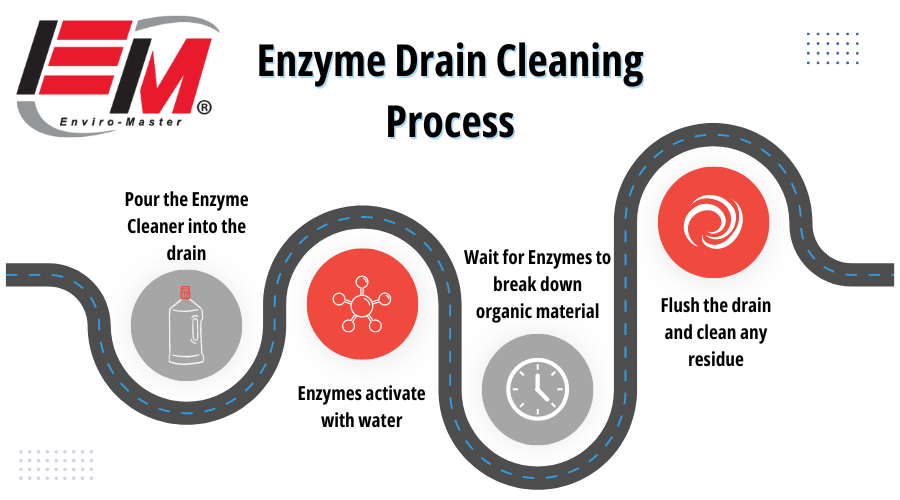
Enzyme-based drain cleaners work on compatible organic waste by using enzymes as catalysts. Lipase acts on fats, oils, and grease, while amylase targets starches and protease works on proteins. Some bio-enzymatic formulas also add live bacteria that consume smaller organic particles and may create additional enzymes.
This process can reduce residue without relying on a harsh chemical reaction or drain-clearing tool. It usually needs more contact time than a caustic cleaner, and results depend on the formula, drain conditions, and type of buildup.
What Can and Cannot Be Treated with Enzyme Cleaners?
Enzyme cleaners work best on compatible organic residue, including grease film, food particles, starch, proteins, and some soap-related buildup. Regular treatment may help manage material that contributes to recurring odors and slow flow in high-use commercial drains.
These products do not work equally well on every clog. Hardened grease, compacted hair, mineral scale, roots, wipes, foreign objects, and complete blockages may need mechanical removal or plumbing service. A formula that helps with light hair residue may not clear a dense hair clog unless it contains enzymes made for keratin.
An enzyme cleaner is also unlikely to fix a drain that has already backed up or stopped flowing. Waiting hours for biological action can let an urgent problem get worse. Match the treatment to the drain problem instead of assuming every clog needs the same approach.
Benefits of Enzyme Drain Cleaning Power
Compared with common ways to clear a clogged drain, such as a caustic cleaner or drain-clearing tool, enzyme drain cleaners can offer several practical benefits. Key benefits of enzyme drain cleaning products include:
Compatible With Many Pipes When Used as Directed
Caustic drain cleaners use a chemical reaction to break down compatible organic material. Some are strong enough to cause burns and may affect certain pipes, seals, finishes, or older plumbing parts when used incorrectly.
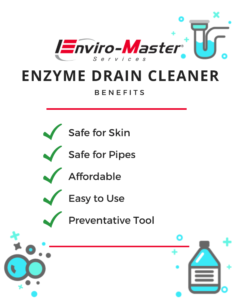
Enzyme drain cleaners generally do not use the same corrosive reaction. Facilities should still check the product label for approved pipe materials, handling directions, and application limits. No drain cleaner should be assumed suitable for every pipe or plumbing system.
Affordable and Easy to Use
Professional plumbers often clear clogged drains with tools such as a drain snake. These tools can be costly to buy and may be difficult for employees without proper training to use correctly.
Enzyme drain cleaners are often easier to add to a routine maintenance plan when used according to the label. They do not replace professional plumbing equipment, but recurring treatment may help facilities manage compatible organic buildup before it becomes a larger problem.
Ideal For Preventative Maintenance
Because they may damage pipes and require careful handling, caustic drain cleaners are usually used after a problem develops. Drain-clearing tools are also generally used to remove a blockage rather than manage gradual organic buildup.
Enzyme drain cleaners work best as part of preventive drain care. Applying a compatible enzyme drain cleaner on a regular schedule can help reduce organic matter inside the drain line and lower the chance of recurring slow flow or odors.
Their potential affordability and ease of use can make enzyme cleaners a practical part of preventive drain maintenance. This matters for business owners who want to avoid downtime, unexpected service calls, and drain odors that can leave customers with a poor impression.
Enzyme Drain Cleaner vs. Chemical Drain Cleaner
Choosing between an enzyme drain cleaner and a chemical drain cleaner depends on what is causing the problem, the condition of the plumbing, and how quickly your facility needs a result. Enzymatic products work gradually and are best for recurring organic buildup in drains that still flow.
Chemical cleaners may contain sodium hydroxide, sulfuric acid, hydrochloric acid, bleach, or other reactive ingredients. Some can break down compatible material faster, but they may create heat or fumes and affect certain plumbing materials. Facility employees should review the product label and data sheet before use.
Chemical products are not a universal answer for tough clogs. They will not repair damaged pipes, remove roots, or retrieve foreign objects. For a complete blockage, backup, or unknown obstruction, mechanical clearing or professional plumbing support is usually the better choice.
Grease traps need extra care. Some local wastewater authorities restrict enzymes, bacteria, and chemical additives because loosened grease may move downstream and harden elsewhere. No additive replaces required grease removal, pumping, inspection, or recordkeeping.
Enzyme Drain Cleaning Process in Commercial Settings
A practical way to use enzyme drain cleaners in commercial settings is through a commercial cleaning service that includes drain treatment in routine service. At Enviro-Master, we help clients reduce buildup that contributes to clogged and slow drains by routinely applying high-quality enzyme drain cleaners. Our drain cleaning services are designed to provide:
- Cost-effective preventive drain maintenance
- Support for controlling drain odors
- Consistent scheduled treatment
- Formulas selected for commercial drain care
- A recurring, environmentally friendly alternative to reactive drain maintenance
Enzyme drain cleaners can take time to work. The main tradeoff compared with some caustic cleaners is that enzymatic action is gradual. Many products must stay in a low-use drain for several hours or overnight, but the correct contact time depends on the formula and label directions.
A facility should not rely on a slow-acting product when a drain is fully blocked or overflowing.
Our Foaming Drain Line Service is especially useful for restaurants, bars, and other food businesses that use drains heavily and often deal with recurring buildup. We also provide this service to many gyms, healthcare facilities, schools, and other commercial properties to help keep drains flowing and reduce foul odors that can affect customer impressions.
Maintenance Dose vs. Treating a Slow Drain
Some enzyme-product labels recommend monthly applications for drains that still flow. High-use commercial drains may need more frequent service based on waste volume, drain type, plumbing layout, and past problems. The product label or professional service plan should guide the schedule.
A slow drain may need an initial treatment followed by recurring maintenance. Facility employees should not assume that a larger dose will work faster or give better results. Use the listed amount and allow the required contact time before running water through the line.
Garbage disposals need special care. Shut off and disconnect the equipment before inspecting it, and never place a hand inside the opening. Confirm that both the disposal manufacturer and enzyme-product label allow the treatment before applying it.
After the required standing time, follow the product directions for flushing the line and restarting the disposal. Never combine an enzyme product with a chemical drain cleaner. Facilities should also track applications, flow problems, odors, backups, and follow-up results to see whether the maintenance plan is working.
Enviro-Master’s Drain Treatment Service with Enzyme Bio-Active Foam
At Enviro-Master, we offer a weekly Foaming Drain Line Service designed to reduce clogged drains and the problems they create for commercial building owners. Each week, our trained technicians apply a high-quality formula to drains and drain lines throughout your building. By helping keep drains clear of organic buildup, our service can provide benefits such as:
- Keeping drains free of unpleasant odors by reducing food particles before they begin to release odors
- Reducing buildup to help your drainage system work more efficiently
- Reducing reliance on harsh chemical solutions for routine drain care
- Lowering the chance of clogged drains disrupting your commercial building
- Helping reduce unexpected plumbing costs
A drain may be out of sight, but odors, slow flow, and backups are hard to ignore. Weekly professional treatment makes drain care one less recurring task for your employees while helping your facility stay clean, presentable, and ready for customers. Regular service can also help your team stay ahead of the organic buildup that often leads to noticeable drain odors and slower flow. That matters in busy restaurants, offices, gyms, schools, and other commercial spaces where customers and employees may notice a problem before anyone has time to address it. With a set weekly service, drain care becomes part of the cleaning routine instead of another task your staff has to remember. Our technicians treat the drains on schedule, track concerns, and help you maintain a space that looks cared for. The goal is simple: fewer drain distractions and a cleaner impression for everyone who walks into your business.
Monitoring and When to Call a Plumber
Employees should review the complete product label and product data sheet before applying any drain cleaner. Follow all listed handling directions and use any required protective equipment. Never mix enzyme cleaners with bleach, acids, caustic products, or another unknown treatment.
Keep a written log of the product, application date, drain location, standing time, observed flow, odor complaints, and follow-up results. These records help managers spot recurring trouble areas and judge whether the treatment schedule is working.
Call a qualified plumber when a drain is completely blocked, wastewater is backing up, several fixtures are affected, or the same problem keeps returning. Mineral scale, roots, damaged pipes, and foreign objects also need professional evaluation. A plumber may use a snake, auger, hydro jetting equipment, or camera inspection to find and remove the obstruction.
Product ingredients and wastewater requirements should also be documented for facility records. Claims such as “biodegradable,” “septic-safe,” or “eco-friendly” should only be used when supported by product documentation. Septic compatibility does not mean an additive is necessary for septic-system performance.
Other Commercial Cleaning Services From EM
Along with our Foaming Drain Line Service, we offer other commercial cleaning services that help businesses keep customer-facing spaces clean and presentable. These services include:
Restroom & Hygiene Service – Our weekly Restroom & Hygiene Service addresses odors, buildup, and high-impact surfaces so your restroom supports a cleaner, more professional impression.
Tile & Grout Deep Cleaning Service – Dirt and residue can settle into grout lines where routine mopping cannot reach. We use specialized equipment and professional cleaning products to remove buildup that basic surface cleaning leaves behind.
Electrostatic Spraying Service – Our electrostatic spraying process provides broad, even product coverage across hard and soft surfaces as part of your existing commercial cleaning routine.
Paper Management Program – Our Paper Management Program helps keep restroom paper products stocked while reducing waste through specially designed dispensing equipment.
Hand Hygiene Program – Our Hand Hygiene Program provides convenient dispensers that our trained technicians service and keep stocked for your facility.
Commercial Cleaning Products From EMS
Along with the commercial cleaning products we use during service, we also offer high-quality products for sale at discounted rates. These products can support your regular business cleaning routine and help keep the facility presentable between EM’s deep cleaning jobs.
Commercial cleaning products available for purchase from Enviro-Master include:
- Enzymatic Floor Cleaner
- Enzyme Drain Cleaner
- Concentrated Cleaners and Degreasers
- Dishwashing Detergent
- Hard Surface Cleaners for stubborn commercial stains
- Odor Neutralizers and Air Fresheners
- Oven & Grill Cleaner
- Neutral Cleaner Concentrate
Contact EMS For Commercial Cleaning Products & Services
Do not wait for recurring odors, slow flow, or an unexpected backup to leave customers with the wrong impression. Enviro-Master provides dependable drain treatment that addresses organic buildup routine cleaning can miss.
Our trained technicians show up, follow through, and provide consistent weekly service built around your facility. If you would like to learn more about our Foaming Drain Line Service, enzyme drain cleaner, or other commercial cleaning products and services, contact us today.
Frequently Asked Questions
How Long Does Enzyme Drain Cleaner Take to Work?
Enzyme cleaners generally need several hours instead of several minutes. Some formulas are designed to remain in a low-use drain overnight, but the correct contact time depends on the label, buildup, drain conditions, and product. There is no single time frame that applies to every formula.
Does Enzyme Drain Cleaner Really Work on Tough Clogs?
An enzyme cleaner may help reduce compatible organic buildup in a drain that still flows. It is unlikely to clear a complete blockage, hardened mineral scale, roots, damaged plumbing, or a foreign object. Tough or recurring clogs should be inspected and cleared by a qualified plumber.
Is Enzyme Drain Cleaner Suitable for Pipes and Septic Systems?
Many enzymatic products are made without the caustic or acidic ingredients used by conventional drain openers. However, pipe and septic compatibility must be confirmed on the product label. Use the product only as directed, and do not assume that a septic-compatible additive improves septic-system performance.
How Often Should You Use Enzyme Drain Cleaner for Maintenance?
Some products recommend monthly treatment, while high-use commercial drains may need a different schedule. Follow the product label and base the frequency on facility demand, service records, and professional recommendations. Enviro-Master applies its foaming drain treatment weekly for consistent commercial maintenance.
Enzyme Drain Cleaner vs. Chemical Drain Cleaner – Which Is Better for Grease Traps?
Where local rules and product directions allow them, enzyme products may support maintenance without relying on caustic chemistry. Chemical cleaners can create handling concerns and may move grease instead of solving the facility’s maintenance problem. Neither option replaces required grease removal, inspection, pumping, or local wastewater compliance.
