Revolving doors. Banisters. Entryway floors and mats. Restroom stalls and sinks. These are among the busiest areas in any commercial facility, whether you run a school, healthcare facility, restaurant, or office building.
People move through these spaces constantly, and they use what they see to frame an opinion about your facility and about you. A scuffed entryway floor or a poorly kept restroom tells visitors something about your business before you ever get a chance to make your case.
Keeping these areas clean and well maintained is one of the simplest ways to make a strong, lasting impression. Here is a five-step checklist to help you do exactly that.
Here Are 5 Steps to Keep High-Traffic Areas Looking Their Best
From the mat at your front door to the grout lines in your restroom floor, the condition of your highest-traffic areas reveals exactly how much attention they’ve received. Here are five ways to ensure your high-traffic areas are sending the right signal.
Step 1: Know Your Floors
Your floors take more abuse than any other surface in your facility, and the wrong product or technique can leave them looking dull, damaged, or worn before their time. Not only do you have to differentiate between carpet and hard flooring, but the specific type of fibers, tile, wood, or other material matters too.
Carpet cleaning: Carpet requires regular vacuuming and periodic deep cleaning to pull out the dirt that daily foot traffic pushes deep into the fibers. The right vacuum setting will depend on the height of your carpet pile while deep cleaning methods depend on the type of fiber.
Hard floors cleaning: Hard floors need consistent sweeping and mopping with the right products to stay looking bright and presentable without dulling their finish or damaging protective coating. Tile floors require close attention to keep grout lines clean, while concrete floors may require buffing or sealing to maintain appearance.
Whether you have carpet, hard floors, or a mix of both, a professional cleaning service understands the specific requirements of each floor type and applies the right approach every time.

Step 2: Identify and Clean High-Touch Surfaces
Although they don’t receive scuffs and scratch marks in the same way as floors, high-touch surfaces still receive their fair share of attention throughout each day. Door handles, checkout counters, reception desks, elevator buttons, and stair railings are all susceptible to fingerprints, smudges, stains and more. Without regular attention, these surfaces collect buildup that is visible to every customer and employee who interacts with them.
Keeping high-touch surfaces clean requires more than a once-a-day wipe-down. If you don’t have the manpower for this type of commitment, enlist a professional cleaning service to tackle the day-to-day upkeep.
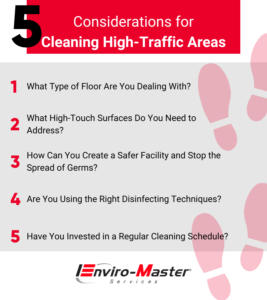
Step 3: Map Out Your Highest-Traffic Zones
Mapping out your highest-traffic zones allows you to focus your cleaning efforts where they matter most. For example:
- Entrances: Front entrances greet nearly every person who walks through your door. Note which entrances are most popular and which are off limits or used sparingly.
- Lobbies: Check-in and waiting areas are where customers tend to look around and form their first impressions of your interior.
- Restrooms: Often the busiest room in any building, restrooms see constant use and require specialized cleaning to remain fresh and welcoming.
- Stairways and elevators: These spaces serve as connectors between floors and accumulate dirt and fingerprints quickly.
Identifying your most popular spaces and the times when they are busiest can help you map out an effective cleaning schedule. If you need assistance with evaluating and prioritizing these areas, bring in a commercial cleaning team to assess your space and build a targeted plan for your facility.
Step 4: Use the Right Products and Techniques
poor results, such as streaks, surface damage, or a space that still does not look quite right after cleaning. Professional-grade products and proven application methods deliver a level of clean that is difficult to match without proper training and equipment.
If your goal is to cover every nook and cranny to ensure broad and professional-grade coverage, consider bringing in specialized equipment. Electrostatic spraying, for example, is an advanced technique that covers surfaces evenly and thoroughly, reaching areas that manual cleaning often misses. Professional cleaning services bring these tools and techniques directly to your business, removing the guesswork and delivering consistent, visible results every time.
Step 5: Stick to a Regular Cleaning Schedule
A one-time deep clean will not deliver the long-term results you’re looking to achieve. For visible results, a strict routine with daily, weekly, and monthly tasks will ensure every area gets the right level of attention at the right time.
Daily task examples:
- Wiping down high-touch surfaces, like countertops, desks, and restroom fixtures
- Sweeping high-traffic floors
- Vacuuming high-traffic rugs or carpet
- Trash removal
Weekly task examples:
- Mopping
- Restroom deep cleaning
- Electrostatic spraying high-use rooms
Monthly task examples:
- Carpet treatment
- Tile and grout deep cleaning
When your cleaning schedule runs consistently, your space looks consistently impressive rather than just occasionally clean.
Ready for a Truly Clean Business? Contact Enviro-Master Today
A detailed cleaning plan makes a real difference, but the best results come from letting the professionals handle it. Enviro-Master not only specializes in delivering the gold standard in clean for busy businesses, we also know how to create a plan that works with your foot traffic and building use.
Contact Enviro-Master today to find out how we can create a custom cleaning plan that keeps your business at its best every single day.
